Do
understand that you are destined for enlightenment. Co-operate
with your destiny, dont go against it, dont thwart it. Allow it
to fulfil itself. All you have to do is to give attention to the
obstacles created by the foolish mind.
You need not get at it (Enlightenment), for
you are it. It will get at you, if you give it a chance. Let
go your attachment to the unreal and the real will swiftly and
smoothly slip into its own. Stop imagining yourself being or
doing this or that and the realisation that you are the source
and heart of all will dawn upon you.
The
real does not die, the unreal never lived.
Once you realise that the person is merely a
shadow of the reality, but not the reality itself, you cease
to fret and worry. You agree to be guided from within and life
becomes a journey into the unknown.
Above quotations from I Am That Published
by Chetana
Who
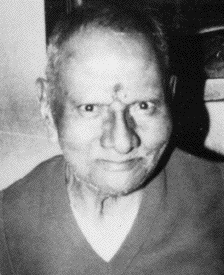
is Nisargadatta Maharaj?
-The
only difference between us is that I am aware of my natural
state, while you are bemused. Just like gold made into
ornaments has no advantage over gold dust, except when the
mind makes it so, so are we are in being - we differ only in
appearance. We discover it by being earnest, by searching,
enquiring, questioning daily and hourly, by giving oneís life
to this discovery.
-.......I see no difference between you and me. My life is a
succession of events, just like yours. Only I am detached and
see the passing show as a passing show, while you stick to
things and move along with them.
-Yes, I appear to hear and see and talk and act, but to me it
just happens, as to you digestion or perspiration happens. The
body-mind machine looks after it, but leaves me out of it.
Just as you do not need to worry about growing hair, so I need
not worry about words and actions. They just happen and leave
me unconcerned, for in my world nothing ever goes wrong.
-Pleasure and pain lost their sway over me. I was free from
desire and fear. I found myself full, needing nothing.
-To me it is 'a body', not 'my body', 'a mind'. not 'my mind'.
The mind looks after the body all right, I need not interfere.
-Whatever is done, is done on the stage. Joy and sorrow, life
and death, they all are real to the man in bondage; to me they
are all in the show, as unreal as the show itself.
-To me nothing ever happens. There is something changeless,
motionless, immovable, rock-like, unassailable; a solid mass
of pure being-consciousness-bliss. I am never out of it.
Nothing can take me out of it, no torture, no calamity.
-All is attended to in minutest details and yet there is a
sense of unreality about it all. So is the case with me. All
happens as it needs, yet nothing happens. I do what seems to
be necessary, but at the same time I know that nothing is
necessary, that life itself is only a make-belief
-There was discovery and it was sudden. Just as at birth you
discover the world suddenly, as suddenly I discovered my real
being.
-I am neither conscious nor unconscious. I am beyond the mind
and its various states and conditions....A person is a set
pattern of desires and thoughts and resulting actions; there
is no pattern in my case. There is nothing I desire or fear -
how can there be a pattern.
Above quotations fromI Am
That Published
by Chetana
http://nisargadatta.co.cc
This comprehensive web
site on Nisargadatta Maharaj is full of well
presented information
containing much material on Nisargadatta Maharaj,
lists of books and
videos, free downloads, quotes and a large collection of photos.
Highly recommended
http://nisargadatta.we.bs/
Comprehensive
site
with
all
10
books
of Nisargadatta Maharaj available
for free download.
Non Duality
saloon
Comprehensive -
includes audio quotes of Nisargadatta Maharaj
Quotations on Emptiness
1 - A Course in Miracles
What God did not create does not exist. And everything that does
exist exists as He created it. The world you see has nothing to
do with reality. It is of your own making, and it does not
exist.
Lesson 14 A Course in Miracles
There is no life outside of Heaven. 2 Where God created life,
there life must be. 3 In any state apart from Heaven life is
illusion. 4 At best it seems like life; at worst, like death. 5
Yet both are judgments on what is not life, equal in their
inaccuracy and lack of meaning. 6 Life not in Heaven is
impossible, and what is not in Heaven is not anywhere. 7 Outside
of Heaven, only the conflict of illusion stands; senseless,
impossible and beyond all reason, and yet perceived as an
eternal barrier to Heaven. 8 Illusions are but forms. 9 Their
content is never true.
T-23.II.19 A Course in Miracles
Recognition of meaninglessness arouses intense anxiety in all
the separated ones. 2 It represents a situation in which God and
the ego "challenge" each other as to whose meaning is to be
written in the empty space that meaninglessness provides. 3 The
ego rushes in frantically to establish its own ideas there,
fearful that the void may otherwise be used to demonstrate its
own impotence and unreality. 4 And on this alone it is correct.
It is essential, therefore, that you learn to recognize the
meaningless, and accept it without fear. 2 If you are fearful,
it is certain that you will endow the world with attributes that
it does not possess, and crowd it with images that do not exist.
3 To the ego illusions are safety devices, as they must also be
to you who equate yourself with the ego.
Lesson 13 A Course in Miracles
There is no world. This is the central thought the course
attempts to teach.
Lesson 132. A Course in Miracles
The thoughts of which I am aware do not mean anything because I
am trying to think without God. What I call "my" thoughts are
not my real thoughts. My real thoughts are the thoughts I think
with God. I am not aware of them because I have made my thoughts
to take their place.
Lesson 51 A Course in Miracles
Nothing in this room means anything. (Lesson 1)
.... The reason this is so is that I see nothing, and nothing
has no meaning. It is necessary that I recognise this, that I
may learn to see.. (Lesson 51)
.... What do you know about this cup except what you learned in
the past? You would have no idea what this cup is, except for
your past learning. Do you, then, really see it? Look about you.
This is equally true of whatever you look at. (Lesson 7) A Course in Miracles
The cause of pain is separation, not the body, which is only its
effect. 2 Yet separation is but empty space, enclosing nothing,
doing nothing, and as unsubstantial as the empty place between
the ripples that a ship has made in passing by. 3 And covered
just as fast, as water rushes in to close the gap, and as the
waves in joining cover it.
T-28.III.5. A Course in Miracles
God knows not form. 6 He cannot answer you in terms that have no
meaning. 7 And your will could not be satisfied with empty
forms, made but to fill a gap that is not there. 8 It is not
this you want.
T-30.III.4. A Course in Miracles
Who dwells with shadows is alone indeed, and loneliness is not
the Will of God. 2 Would you allow one shadow to usurp the
throne that God appointed for your Friend, if you but realized
its emptiness has left yours empty and unoccupied? 3 Make no
illusion friend, for if you do, it can but take the place of Him
Whom God has called your Friend. 4 And it is He Who is your only
Friend in truth. 5 He brings you gifts that are not of this
world, and only He to Whom they have been given can make sure
that you receive them. 6 He will place them on your throne, when
you make room for Him on His.
T-26.VI.3. A Course in Miracles
Nothing real can be threatened.
Nothing unreal exists.
Herein lies the peace of God
intro,Text A Course in Miracles
2 - Buddhism
When you ride in a boat and watch the shore, you might assume
that the shore
is moving. But when you keep your eyes closely on the boat, you
can see that the boat moves. Similarly, if you examine myriad
things with
a confused body and mind you might suppose that your mind and
nature
are permanent. When you practice intimately and return to where
you are,
it will be clear that nothing at all has unchanging self.
Zen Master Dogen, Moon in a Dewdrop, edited by Kazuaki Tanahashi
There is something quite strange about the inherently existent
I. If we do not investigate it, it will appear all the time and
even in our dreams we shall grasp at it; but as soon as we
actually examine it, it becomes very unclear. As we search for
it, instead of being able to locate it we lose it. This very
experience is a sign that the I does not exist from its own
side, because if it did exist from its own side investigation
would reveal it more and more clearly. The same applies to
external objects. For example, if we do not look at a rose too
closely, whenever we glance in its direction the rose will
appear to us. However, if we start to analyze it, trying to find
what is the rose, we shall find many parts of the rose but we
shall not find the rose itself. The more closely we investigate,
the more difficult it becomes to see the rose. Usually if
someone says 'Where is the rose?' we point in its direction and
say 'There it is!'; but if through investigation we look more
closely we shall not be able to locate the rose itself. This
kind of experience is a sign indicating that phenomena other
than persons also lack inherent existence or true existence.
Persons and phenomena do not exist from their own side. from Joyful Path of Good Fortune by Geshe Kelsang Gyatso
Tharpa Publications 1986
Un-conditioned and conditioned phenomena i.e. matter, mind and
non-associated compositional factors do not truly exist. All
phenomena are dependent on three things:
Causes and conditions
Parts and directions or moments
Mental imputation or label
Then, is everything non-existent? If things did not exist, they
could not affect us, but pain and pleasure do exist. When, with
respect to any phenomenon, the object designated is sought, it
is not found in the place where it was thought to exist;
however, that it is non-existent is contradicted by experience,
Therefore, since it is the case that the phenomenon being sought
certainly exists but is not found under analysis, it can be
concluded that it is not established under its own power but
exists through the force of other conditions. What are those
conditions? Conceptual consciousnesses that designate phenomena.
Thus, it is inevitably established that phenomena exist through
the force of, or in dependence upon, imputation by
conceptuality.
H.H. the Dalai Lama
When our mind perceives (e.g.) a bell, it does not see a bell
that is merely labeled by the mind. It sees something slightly
beyond that, ever so slightly more than that. It sees something
as existing from the side of the bell, something existing from
its own side, from the side of the object. If you concentrate,
if you analyze carefully how the bell exists, that it is merely
labeled by the mind, you can see that there's nothing coming
from the side of the bell. When you look deeply into the meaning
of "merely labeled by the mind," you can see that nothing exists
from the side of the object. When you concentrate on this, you
can see how its existence comes only from your mind. Lama Zopa Rinpoche
Whatever you perceive, whatever you proclaim - there is nothing
that has not come from your own mind. Understand that this
realization of mind is empty. Understanding the non-duality of
the realization of mind and of voidness is wisdom. Meditation is
the continuous concentration on this wisdom without any
distraction. Deeds are accumulating merit and wisdom while you
realize from the viewpoint of this meditation, that everything
is like an illusion.Once you are under the influence of these
three, their practice will come even in dreams. Once it has come
in dreams, it will come at the moment of death. When it comes at
the moment of death, it will be present in the bardo. Once it is
present in the bardo, there is certain to be accomplishment of
the superior Siddhi, and you will become a Buddha.
Atisha
First there is the thought that
simply labels I upon the (5) aggregates (form, feeling,
perception, mental activities, consciousness). Then there is the
appearance of this I to exist from its own side, and as soon as
the thought believes in this appearance to be real, that thought
becomes ignorance. It is a wrong conception because the object
does not exist in reality. This is how the object is a
hallucination; the ignorance that motivates karma is
hallucinated with respect to the nature of the I.
Lama Zopa Rinpoche
While you are looking into exactly how the I instinctively
appears to you, the I may present itself in various ways.
Sometimes the I may be something imputed on the body, sometimes
on the mind. This is not the genuine way the 'I' presents itself
to the instinctive grasping of the 'I'. The body and mind, which
are the bases of imputation, as well as the person - the imputed
phenomenon - all merge into the one broad set. The self-evident
'I' plainly appears to be something rather more than an idea
imputed on this set. It appears instead to be something
established as being self-contained: a distinct unit on its
own.... The self-evident 'I' will arise on top of the mind and
body.... If the 'I' seems to be like this, you have rightly
perceived the way the object to be refuted appears to you. Once
recognized, it is easy to refute.
Pabongka Rinpoche
If the aggregates were the self, it follows that,
As they are many, the self too would be multiple.
Chandrakirti
You should now be clear about the way in which the object to be
refuted is supposed to exist. The significance of the way in
which the self and the aggregates could be established as the
one thing is that they would not appear separately to the mind:
they would be completely inseparable, being necessarily the same
thing. These reasons restrict them to the one distinct entity.
Yet the way they appear does not accord with the way they are
supposed to exist - this would make them false even at the
relative level. But how could that happen when a thing is
supposed to be established as true: the way it appears would
have to correspond with the way it exists. Consequently, it
would be pointless to posit a self. To say 'the self's
aggregates' would be no different from saying 'the aggregates'
aggregates' or 'the self's self.' It would be pointless to make
the distinction between 'the self and 'the self's aggregates.'
Pabongka Rinpoche
Now that you are certain they are not the same, you should feel,
'All that remains is for the self and the aggregates to be
established as separate by nature.' If they were shown to be
naturally separate then, as it says in The Root of
Wisdom: It would be possible to perceive it without there
being any aggregates, but it is not so perceived. In other
words, when you eliminate the goat and sheep from a group
consisting of a sheep, a goat, and a bull, you are able to point
to the remaining animal and say, 'There's the bull!' You must
similarly be able to identify something that is unconnected with
the aggregates called the 'I' which would be the residue after
eliminating each of the five aggregates - form, feeling,
recognition, compositional factors, and consciousness. But you
do not, in fact, come to identify such a thing.
Pabongka Rinpoche
If it were different from the aggregates
It would not have
The characteristics of the aggregates.
Nagarjuna
In general, if a phenomenon exists, it must necessarily be
singular or plural. Generally this is the full set of
possibilities, and if a particular thing exists truly it must
necessarily be either truly singular or truly plural. It is
quite certain that this covers all cases; it therefore also
applies to such an `I`, which can only be either the same as the
aggregates, or separate from them. This key point should lead
you to the certainty that, 'If it is neither of these two, it
cannot exist.' You must meditate on this key point, not merely
for a day or two, but until you gain unshakable conviction in
it.
Pabongka Rinpoche
While you are meditating there is an I which appears to exist
from its own side. Right on top of that think, the I is merely
labelled. Just meditate on the meaning of the I being merely
labelled. I is a name; a name does not exist from its own side,
a name is given, imputed by the mind. We can completely agree
with that. This I is merely labelled; concentrate on just that.
Try to feel that. This automatically eliminates eternalism, the
view of a truly existent I.
Lama Zopa Rinpoche
3 - Ramana
Maharshi
1 . Who am I ? The gross body which is composed of the seven humours
(dhatus), I am not; the five cognitive sense organs, viz. the
senses of hearing, touch, sight, taste, and smell, which
apprehend their respective objects, viz. sound, touch, colour,
taste, and odour, I am not; the five cognitive sense-organs,
viz. the organs of speech, locomotion, grasping, excretion, and
procreation, which have as their respective functions speaking,
moving, grasping, excreting, and enjoying, I am not; the five
vital airs, prana, etc., which perform respectively the five
functions of in-breathing, etc., I am not; even the mind which
thinks, I am not; the nescience too, which is endowed only with
the residual impressions of objects, and in which there are no
objects and no functioning's, I am not. 2. If I am none of these, then who am I? After negating all of the above-mentioned as 'not this',
'not this', that Awareness which alone remains - that I am. 3. What is the nature of Awareness? The nature of Awareness is existence-consciousness-bliss 4. When will the realization of the Self be gained? When the world which is what-is-seen has been removed, there
will be realization of the Self which is the seer. 5. Will there not be realization of the Self even while the
world is there (taken as real)? There will not be. 6. Why? The seer and the object seen are like the rope and the
snake. Just as the knowledge of the rope which is the substrate
will not arise unless the false knowledge of the illusory
serpent goes, so the realization of the Self which is the
substrate will not be gained unless the belief that the world is
real is removed. 7. When will the world which is the object seen be removed? When the mind, which is the cause of all cognition's and of
all actions, becomes quiescent, the world will disappear. 8. What is the nature of the mind? What is called 'mind' is a wondrous power residing in the
Self. It causes all thoughts to arise. Apart from thoughts,
there is no such thing as mind. Therefore, thought is the nature
of mind. Apart from thoughts, there is no independent entity
called the world. In deep sleep there are no thoughts, and there
is no world. In the states of waking and dream, there are
thoughts, and there is a world also. Just as the spider emits
the thread (of the web) out of itself and again withdraws it
into itself, likewise the mind projects the world out of itself
and again resolves it into itself. When the mind comes out of
the Self, the world appears. Therefore, when the world appears
(to be real), the Self does not appear; and when the Self
appears (shines) the world does not appear. When one
persistently inquires into the nature of the mind, the mind will
end leaving the Self (as the residue). What is referred to as
the Self is the Atman. The mind always exists only in dependence
on something gross; it cannot stay alone. It is the mind that is
called the subtle body or the soul (jiva). 9. What is the path of inquiry for understanding the nature
of the mind? That which rises as 'I' in this body is the mind. If one
inquires as to where in the body the thought 'I' rises first,
one would discover that it rises in the heart. That is the place
of the mind's origin. Even if one thinks constantly 'I' 'I', one
will be led to that place. Of all the thoughts that arise in the
mind, the 'I' thought is the first. It is only after the rise of
this that the other thoughts arise. It is after the appearance
of the first personal pronoun that the second and third personal
pronouns appear; without the first personal pronoun there will
not be the second and third. 10. How will the mind become quiescent? By the inquiry 'Who am I?'. The thought 'who am I?' will
destroy all other thoughts, and like the stick used for stirring
the burning pyre, it will itself in the end get destroyed. Then,
there will arise Self-realization. 11. What is the means for constantly holding on to the
thought 'Who am I?' When other thoughts arise, one should not pursue them, but
should inquire: 'To whom do they arise?' It does not matter how
many thoughts arise. As each thought arises, one should inquire
with diligence, "To whom has this thought arisen?". The answer
that would emerge would be "To me". Thereupon if one inquires
"Who am I?", the mind will go back to its source; and the
thought that arose will become quiescent. With repeated practice
in this manner, the mind will develop the skill to stay in its
source. When the mind that is subtle goes out through the brain
and the sense-organs, the gross names and forms appear; when it
stays in the heart, the names and forms disappear. Not letting
the mind go out, but retaining it in the Heart is what is called
"inwardness" (antar-mukha). Letting the mind go out of the Heart
is known as "externalisation" (bahir-mukha). Thus, when the mind
stays in the Heart, the 'I' which is the source of all thoughts
will go, and the Self which ever exists will shine. Whatever one
does, one should do without the egoity "I". If one acts in that
way, all will appear as of the nature of Siva (God).
from Who Am I?Ramana Maharshi
Comparison of the Essence
of Wisdom Sutra
and A Course in Miracles ®
Nothing real can be
threatened.
Nothing unreal exists.
Herein lies the peace of God
intro,Text A Course in Miracles
Non - dualistic teachings from A Course in Miracles:
*God is eternal, formless, perfect, limitless and changeless.
*God can only create like itself - an extension of itself.
*What God creates is therefore eternal (never born) and without
form (does not exist in space).
*Only what God creates is real.
*Time and space are illusions and are not known by God.
*God's creation can never change as this would imply time is
real.
*What has form, limits, imperfection, changes and is impermanent
is empty of inherent existence and does not truly exist (void).
Essence of Wisdom
Sutra:
Essence of the perfection of wisdom, the Blessed Mother
Homage to the perfection of wisdom, the Blessed Mother.
Thus I have heard. At one time the Blessed One was dwelling in
Rajagriha on Massed Vultures Mountain together with a great
assembly of monks and a great assembly of Bodhisattvas. At that
time the Blessed One was absorbed in the concentration of the
countless aspects of phenomena, called 'Profound Illumination'.
At that time also the Superior Avalokiteshvara, the Bodhisattva,
the Great Being, was looking perfectly at the practice of the
profound perfection of wisdom, looking perfectly at the
emptiness of inherent existence also of the five aggregates
(form, sensation, perception, mental activities and
consciousness).
What God did not create does not
exist. And everything that does exist exists as He created it.
The world you see has nothing to do with reality. It is of
your own making, and it does not exist.
Lesson 14 A Course in Miracles
Then, through the power of
Buddha, the Venerable Shariputra said to the Superior
Avalokiteshvara, the Bodhisattva, the Great Being, 'How should a
Son of the lineage train who wishes to engage in the practice of
the profound perfection of wisdom?' Thus he spoke, and the
Superior Avalokiteshvara, the Bodhisattva, the Great Being,
replied to the Venerable Shariputra as follows:
'Shariputra, whatever Son or Daughter of the lineage wishes to
engage in the practice of the profound perfection of wisdom
should look perfectly like this: subsequently looking perfectly
and correctly at the emptiness of inherent existence also of the
five aggregates.
There is no life outside of
Heaven. 2 Where God created life, there life must be. 3 In any
state apart from Heaven life is illusion. 4 At best it seems
like life; at worst, like death. 5 Yet both are judgments on
what is not life, equal in their inaccuracy and lack of
meaning. 6 Life not in Heaven is impossible, and what is not
in Heaven is not anywhere. 7 Outside of Heaven, only the
conflict of illusion stands; senseless, impossible and beyond
all reason, and yet perceived as an eternal barrier to Heaven.
8 Illusions are but forms. 9 Their content is never true.
T-23.II.19 A Course in Miracles
Perception is a mirror, not a
fact. And what I look on is my state of mind, reflected
outward . . . Everything you perceive is a witness to the
thought system you want to be true . . .What you project you
disown, and therefore do not believe it is yours.
from A Course in Miracles
(Lesson 304, T192; T-II.V.18:3; T89; T-6.II.2:1) A Course in
Miracles
'Form is empty; emptiness is form. Emptiness is not other
than form; form also is not other than emptiness. Likewise,
feeling, discrimination, compositional factors, and
consciousness are empty.
God knows not form. 6 He cannot
answer you in terms that have no meaning. 7 And your will
could not be satisfied with empty forms, made but to fill a
gap that is not there.
8 It is not this you want. T-30.III.4. A Course in
Miracles
'Shariputra, like this all phenomena are merely empty, having no
characteristics. They are not produced and do not cease. They
have no defilement and no separation from defilement. They have
no decrease and no increase.
My body, Father, cannot be Your
Son. And what is not created cannot be sinful nor sinless;
neither good nor bad. Let me, then, use this dream to help
Your plan that we awaken from all dreams we made. Lesson
294 A Course in Miracles
Therefore, Shariputra, in emptiness there is no form, no
feeling, no discrimination, no compositional factors, no
consciousness. There is no eye, no ear, no nose, no tongue, no
body, no mentality; no form, no sound, no smell, no taste, no
tactile object, no phenomenon. There is no eye element and so
forth up to no mentality element and also up to no element of
mental consciousness. There is no ignorance and no exhaustion of
ignorance and so forth up to no ageing and death and no
exhaustion of ageing and death. Likewise, there is no suffering,
origin, cessation, or path; no exalted awareness, no attainment,
and also no non-attainment.
There is no world. This is the
central thought the course attempts to teach.
Lesson 132. A Course in Miracles
The thoughts of which I am aware do not mean anything because
I am trying to think without God. What I call "my" thoughts
are not my real thoughts. My real thoughts are the thoughts I
think with God. I am not aware of them because I have made my
thoughts to take their place.
Lesson 51 A Course in Miracles
Nothing in this room means anything. (Lesson 1)
.... The reason this is so is that I see nothing, and nothing
has no meaning. It is necessary that I recognise this, that I
may learn to see.. (Lesson 51)
.... What do you know about this cup except what you learned
in the past? You would have no idea what this cup is, except
for your past learning. Do you, then, really see it? Look
about you. This is equally true of whatever you look at.
(Lesson 7)
Lessons from A Course in Miracles
'Therefore, Shariputra, because there is no attainment,
Bodhisattvas rely upon and abide in the perfection of wisdom;
their minds have no obstructions and no fear.
Why wait for Heaven? Those who
seek the light are merely covering their eyes. The light is in
them now. 4Enlightenment is but a recognition, not a change at
all.
Lesson188. A Course in Miracles
Passing utterly beyond perversity, they attain the final
nirvana. Also all the Buddhas who reside perfectly in the three
times, having relied upon the perfection of wisdom, became
manifest and complete Buddhas in the state of unsurpassed,
perfect, and complete enlightenment.
There are those who have reached
God directly, retaining no trace of worldly limits and
remembering their own Identity perfectly. 2 These might be
called the Teachers of teachers because, although they are no
longer visible, their image can yet be called upon. 3 And they
will appear when and where it is helpful for them to do so. 4
To those to whom such appearances would be frightening, they
give their ideas. 5 No one can call on them in vain. 6 Nor is
there anyone of whom they are unaware. 7 All needs are known
to them, and all mistakes are recognized and overlooked by
them. 8 The time will come when this is understood. 9 And
meanwhile, they give all their gifts to the teachers of God
who look to them for help, asking all things in their name and
in no other. M-26.2. A Course in Miracles
'Therefore, the mantra of the perfection of wisdom, the mantra
of great knowledge, the unsurpassed mantra, the
equal-to-the-unequalled mantra, the mantra that thoroughly
pacifies all suffering, since it is not false, should be known
as the truth. The mantra of the perfection of wisdom is
proclaimed:
TAYATHA OM
(It is like this. OM)
GATE GATE PARAGATE
(Go, Go, Perfectly Go)
PARASAMGATE BODHI SÖHA
(Perfectly and Completely Go to Enlightenment. Build the
Foundation)
'Shariputra, a Bodhisattva, a Great Being, should train in the
profound perfection of wisdom like this.'
Then the Blessed One arose from that concentration and
said to the Superior Avalokiteshvara, the Bodhisattva, the Great
Being, that he had spoken well: 'Good, good, O Son of the
lineage. It is like that. Since it is like that, just as you
have revealed, in that way the profound perfection of wisdom
should be practised, and the Tathagatas will also rejoice.'
When the Blessed One had said this, the Venerable Shari-
putra, the Superior Avalokiteshvara, the Bodhisattva, the Great
Being, and that entire circle of disciples as well as the
worldly beings - gods, humans, demi-gods, and spirits - were
delighted
and highly praised what had been spoken by the Blessed One.
The 'Heart of Wisdom' sutra is from: HEART OF WISDOM by Geshe Kelsang Gyatso. Pub: Tharpa
1986
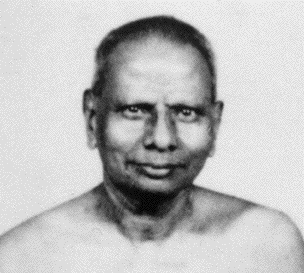
 Nisargadatta Maharaj
 Do
understand that you are destined for enlightenment. Co-operate
with your destiny, dont go against it, dont thwart it. Allow it
to fulfil itself. All you have to do is to give attention to the
obstacles created by the foolish mind.
Do
understand that you are destined for enlightenment. Co-operate
with your destiny, dont go against it, dont thwart it. Allow it
to fulfil itself. All you have to do is to give attention to the
obstacles created by the foolish mind.